Chinese-German team clearly identifies semiconducting nanowires with intrinsic ferromagnetic characteristics.
Hong Kong/Jena (13/07/2009) For a Chinese-German research team the "force of attraction" of minute nanowires is not only based on their special scientific interests: Physicists of the Chinese University of Hongkong and the Friedrich Schiller University Jena were able to prove for the first time that cobalt doped nanowires made from zinc oxide have intrinsic ferromagnetic characteristics - and therefore in principle work like tiny bar magnets. The scientists around Prof. Dr. Quan Li (Hong Kong) and Prof. Dr. Carsten Ronning (Jena) have published the results of their research in the online edition of the well renowned journal "Nature Nanotechnology".
For that Prof. Ronning and his Jena team used their know-how about the preparation of semiconductor nanostructures and their optical characteristics, and doped zinc oxide wires. These were then examined for their magnetic properties by the Chinese colleagues around Prof. Li - an acknowledged expert in the field of electron microscopy. The innovative combination of two analytical methods - transmission electron microscopy and electron magnetic chiral dichroism - is responsible for the surprising outcome. "We realized that cobalt doping gives intrinsic ferromagnetic properties while iron does not", comments Prof. Li. Further investigations must now clarify where these differences come from.
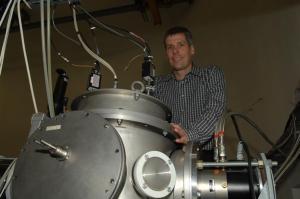
Prof. Ronning (University of Jena) and his Chinese colleagues were able to prove that nanowires show intrinsic ferromagnetic characteristics.
[Photo: Peter Scheere/FSU]
The production of magnetic semiconducting nanowires has so far been basic research, as Quan Li emphasizes. But medium term "we might be able to help push open the door to spintronics". "Spintronics" is a new field in semiconductor physics: While traditional semiconductor electronics is based on the electrons' electrical charge, spintronics additionally uses the spin, the angular momentum, of the electrons. "That momentum can occur in two directions resulting in a magnetic moment", explains Prof. Ronning.
This new development could bring real advantages: Common electronic components need 10.000 to 100.000 electrons for a single switching action. Semiconductor components switching only the spin of electrons need only one electron to transport the necessary information. "That means that spintronic semiconductors could switch much faster than common electronic components", says Quan Li. Furthermore they would need only a fraction of the energy.
The precondition for a further development of spintronics however is, that semiconductors with intrinsic ferromagnetic characteristics can be produced at all. Intense worldwide research has been conducted for about a decade - so far with moderate success: There has not been a method clearly proving intrinsic ferromagnetism so far. Thanks to the current results the physicists have taken the field an important step further.
Further Information and Source:
-
Z. H. Zhang, Xuefeng Wang, J. B. Xu, S. Muller, C. Ronning & Quan Li: Evidence of intrinsic ferromagnetism in individual dilute magnetic semiconducting nanostructures. In: Nature Nanotechnology; published online: 13 July 2009 DOI: 10.1038/nnano.2009.181 URL: direct link
-
Prof. Dr. Quan Li research group, department of physics, The Chinese University of Hong Kong
-
Group Ronning, Institute for Solid State Physics, University of Jena,
Germany