|
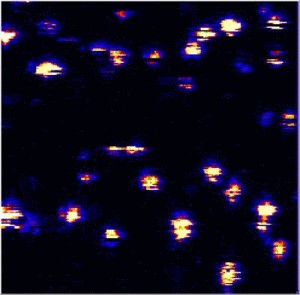
JILA scientists have found a way to suppress the
blinking problem in quantum dots by bathing them in a chemical
solution. This animated image, which demonstrates the basic
blinking phenomenon, is made from a series of 40 images taken
about one minute apart. Quantum dots actually blink on time scales
ranging from millionths of a second to tens of seconds or longer.
Image by K Kuno/JILA
|
By bathing the dots in a watery solution of an
antioxidant chemical used as a food additive, the JILA team increased
photon emission rate four- to fivefold, a �shocking� result because
the rate at which light radiates is generally considered an immutable
property of the dot, JILA/NIST Fellow David Nesbitt says. The JILA
scientists dramatically reduced the average time delay between
excitation of a quantum dot and resulting photon emission from 21
nanoseconds to 4 nanoseconds while reducing the probability of
blinking up to 100 fold. Nesbitt calls blinking the �hidden dirty
secret� of quantum dots. (Nesbitt notes that blinking is not always an
annoyance. For example, it can serve as a measurement probe of very
slow rates of electron flow through nanoscale materials).
The quantum dots used in the JILA experiments were made of
cadmium-selenide cores just 4 nanometers wide coated with zinc sulfide.
When a dot is excited by a brief laser pulse, one electron is
separated from the �hole� it normally occupies. A few nanoseconds
later, the electron typically falls back into the hole, sometimes
producing a single photon�always in a color that depends on dot size,
greenish-yellow in this case. But every so often the electron fails to
make it back to its hole and instead is ejected to imperfections on
the dot�s surface. The chemical added at JILA apparently attaches to
these imperfections, blocking the electron from being trapped and
thereby preventing the dot from blinking off.
|


